


Starting a business in Dubai is one of the most attractive opportunities for entrepreneurs and investors worldwide. With strong infrastructure, investor-friendly regulations, and access to global markets, Dubai has become a leading destination for company formation in the Middle East.
Whether you are a startup founder, SME owner, or international investor, this guide explains exactly how to start a business in Dubai in 2026, including setup steps, costs, licenses, visas, legal structures, and the post-setup compliance obligations that follow.
Quick Summary: How to Start a Business in Dubai
To start a business in Dubai, you need to:
- Choose your business activity
- Select your legal structure
- Choose your jurisdiction (Mainland, Free Zone, or Offshore)
- Reserve your trade name
- Apply for initial approval
- Prepare and submit required documents
- Secure office space, where required
- Obtain external approvals, where applicable
- Pay fees and obtain your business license
- Complete visa processing and corporate bank account opening
Once these steps are completed, your company becomes legally operational in the UAE. The sections below walk through each stage in full depth, along with real cost figures, current 2026 regulatory updates, and the compliance obligations that begin once the license is issued.
Business Setup in Dubai: Key Facts
If you are planning to start a company in Dubai, the cost, timeline, licence and legal requirements depend on your business activity, jurisdiction, office needs and visa requirements. Here is a quick overview.
| Main Business Setup Options | Mainland, Free Zone and Offshore |
| Foreign Ownership | 100% foreign ownership is available for most mainland activities and is standard in UAE free zones, subject to applicable regulations. |
| Typical Setup Time | Simple free zone setups may take approximately 3–7 business days, while mainland setups commonly take around 7–15 business days. Regulated activities can take longer. |
| Typical Starting Cost | Costs vary significantly by jurisdiction, licence, visas and facilities. Some free zone packages start from around AED 12,900, while mainland setups commonly have higher first-year costs. |
| Corporate Tax | UAE Corporate Tax generally applies at 0% on taxable income up to AED 375,000 and 9% above that threshold. Different rules can apply to qualifying free zone income. |
| Residence Visas | Mainland and eligible free zone companies can generally sponsor residence visas, subject to licence, facility and immigration requirements. Offshore companies generally do not provide UAE residence visas. |
| Mainland Licensing Authority | Dubai Department of Economy and Tourism (DET), with additional approvals required for certain regulated activities. |
What is the best way to start a business in Dubai?
There is no single structure that is best for every business. Mainland setup is generally suitable for companies requiring broad UAE market access, while free zones can suit international, consulting, e-commerce and specialised businesses. Offshore structures are generally used for international business, holding and corporate structuring rather than regular operations within Dubai.
Why Start a Business in Dubai?
Dubai continues to attract global investors due to a combination of structural advantages that few other jurisdictions match at the same scale.
1. Strategic Global Location
Dubai sits at the crossroads of Asia, Europe, and Africa, making it a natural base for international trade, logistics, consulting, and e-commerce businesses that need to serve multiple regions from a single hub.
2. Tax-Friendly Environment
The UAE offers 0% personal income tax, a Corporate Tax framework that remains competitive by global standards (9% above a AED 375,000 profit threshold, with 0% below it), and free zone tax incentives for businesses that qualify as a Qualifying Free Zone Person.
3. Strong Business Infrastructure
Dubai offers world-class logistics and ports, a mature banking system, extensive digital government services, and a full range of office and warehouse facilities suited to businesses of any size.
4. Investor-Friendly Regulations
Business registration is streamlined through digital platforms, with multiple licensing authorities (DET for mainland, and dozens of free zones) competing on speed, cost, and service quality.
5. Access to Skilled Talent
Dubai draws a genuinely global workforce across finance, technology, marketing, engineering, and trade, giving businesses access to skills that would take years to build locally in many other markets.
Latest UAE Business Regulations: 2026 Update
Before starting a business, investors should be aware of the current compliance landscape, since some of what circulates online is now outdated.
- 9% Corporate Tax applies to taxable profits above AED 375,000, with a 0% rate below that threshold; mandatory registration for virtually all businesses regardless of profitability
- Mandatory Ultimate Beneficial Owner (UBO) disclosure, with updates to ownership required within a defined period (generally 15 days) of any change, not a one-time filing
- VAT registration required once taxable turnover exceeds AED 375,000 annually, optional above AED 187,500
- Standalone Economic Substance Regulations (ESR) filing was abolished under Cabinet Decision No. 98 of 2024 for financial years starting on or after 1 January 2023. Businesses no longer file separate ESR notifications or reports. The underlying substance concept has not disappeared, though; it now lives inside the Corporate Tax framework, specifically the Qualifying Free Zone Person (QFZP) substance test that determines whether a free zone entity retains its 0% tax rate on qualifying income.
- AML compliance obligations for regulated industries, including real estate brokers, precious metals and stones dealers, and certain financial services activities
- Increased banking due diligence, with UAE banks applying more thorough KYC and source-of-funds review than in previous years, particularly for higher-risk activities
These updates make proper structuring essential before company formation, not something to address retroactively once the business is already operating.
Mainland vs Free Zone vs Offshore: Choosing the Right Jurisdiction
Choosing the correct jurisdiction is one of the most consequential decisions in the entire setup process, since it affects market access, ownership rules, cost, and long-term flexibility.
| Feature | Mainland | Free Zone | Offshore |
|---|---|---|---|
| UAE Market Access | Full, unrestricted | Restricted without a distributor/agent | Not permitted |
| Foreign Ownership | 100% for most activities | 100% standard | 100% standard |
| Office Requirement | Generally required (Ejari) | Flexible; flexi-desk options common | Not required |
| Visa Sponsorship | Yes | Yes, package-dependent | Not available |
| Government Contracts | Eligible | Generally not eligible | Not eligible |
| Best For | UAE-facing trading, retail, contracting | International services, e-commerce, consulting | Holding structures, asset protection |
Mainland Company
Best for: businesses trading directly inside the UAE, bidding on government contracts, or needing a customer-facing physical presence.
- Full access to the UAE market, with no restriction on trading with local clients
- Eligible to bid on government and semi-government contracts
- Following recent Commercial Companies Law amendments, most activities now allow 100% foreign ownership, with a limited list of strategically sensitive activities still requiring additional conditions
- Requires a license from Dubai’s Department of Economy and Tourism (DET)
- Generally requires a registered office with a valid Ejari tenancy contract
Free Zone Company
Best for: international-facing businesses, e-commerce, consulting, and businesses prioritising cost efficiency and fast setup.
- 100% foreign ownership as standard across virtually all free zones
- Potential tax advantages through Qualifying Free Zone Person status, subject to meeting substance and qualifying income conditions
- Flexible office options, including flexi-desk arrangements in many zones
- Generally restricted from direct mainland trading without a distributor or local service agreement
- Dozens of free zones exist across the UAE, each with a different cost structure, activity list, and sector focus, from JAFZA’s port and logistics infrastructure to IFZA’s broad, low-cost general licensing
Offshore Company
Best for: holding structures, international trading, and asset protection rather than day-to-day UAE operations.
- Cannot trade within the UAE market directly
- No physical office requirement
- Cannot sponsor UAE residency visas
- Used primarily for holding assets, intellectual property, or shares in other companies, and for structuring cross-border transactions
If you are still deciding which structure fits your business, our dedicated comparison of
mainland vs free zone business setup in Dubai
walks through the decision in more depth.
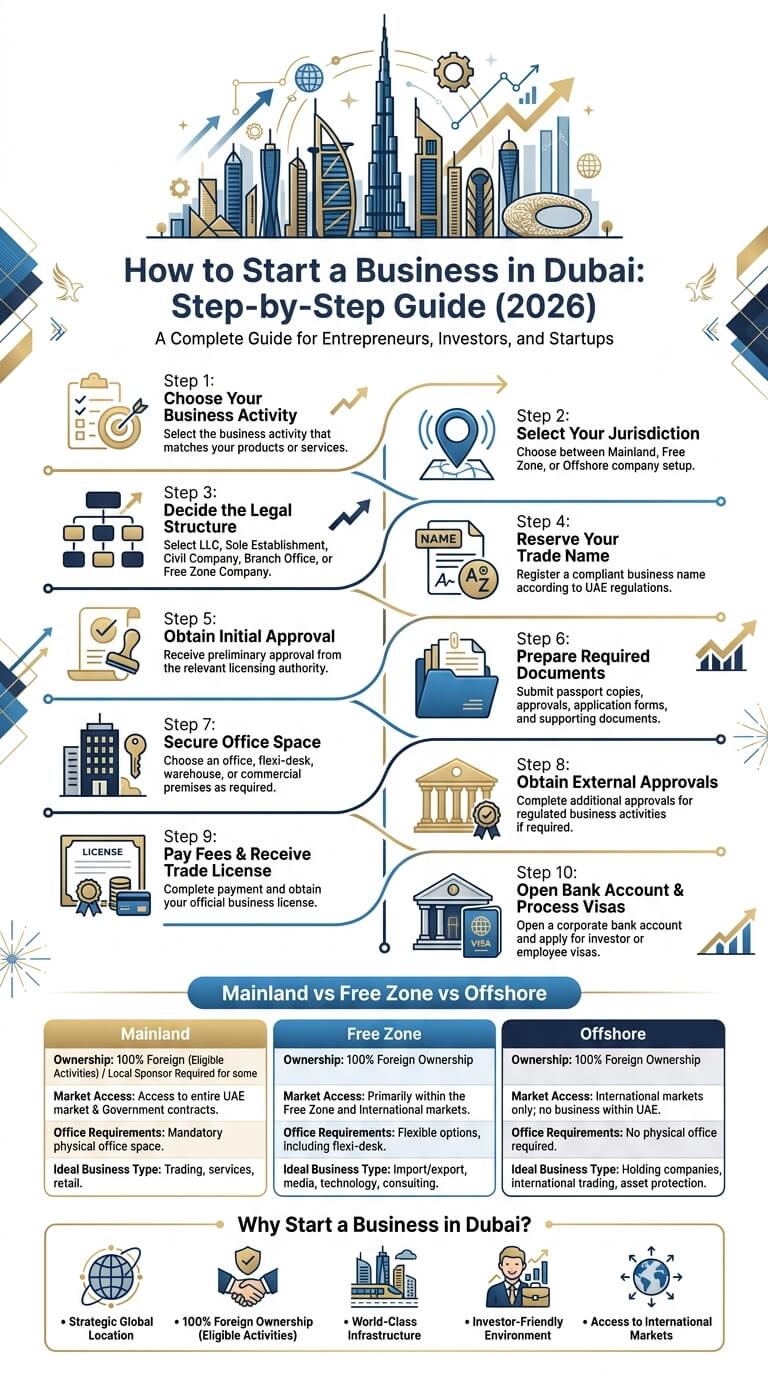
Which Structure Fits Your Business? A Quick Reference
Rather than working through the full comparison every time, it helps to map common business types to the structure that generally fits best:
- A solo consultant serving international clients remotely: typically best served by a free zone professional license, given full ownership, low cost, and no need for mainland market access
- An e-commerce business selling within the UAE: often needs a mainland commercial or e-commerce license, or a free zone license paired with a distributor arrangement, depending on fulfilment model
- A trading company importing and re-exporting goods through a port: strongly suited to a port-connected free zone like JAFZA
- A business bidding for government or semi-government contracts: requires a mainland license, since free zone and offshore entities cannot bid on these directly
- A holding company owning shares in other UAE or international entities, with no active UAE operations: typically suited to an offshore structure
- A financial services or fintech business seeking common law recognition: suited to ADGM or DIFC rather than a standard commercial free zone
This is a starting point, not a substitute for reviewing the specific activity and long-term plans against each jurisdiction’s actual rules.
Step-by-Step Process to Start a Business in Dubai
Step 1: Choose Your Business Activity
Your business activity determines your license type, required approvals, and legal structure options. Common activity categories include trading, consulting, e-commerce, real estate, technology services, and manufacturing. Some regulated activities, healthcare, education, food, financial services, require approval from a specific sector authority before licensing can proceed, so it is worth confirming this early rather than discovering it partway through the application.
Step 2: Select Your Legal Structure
Common structures include an LLC (Limited Liability Company), a Sole Establishment, a Civil Company, a
branch of a foreign company,
a branch of a local company,
or a free zone company (FZE/FZCO). The structure directly affects ownership rules, liability exposure, and taxation, and should be chosen alongside the jurisdiction decision rather than after it.
Step 3: Choose Your Jurisdiction
Decide between mainland, free zone, or offshore, based on the comparison above. This affects where you can legally operate, total cost, and ongoing compliance requirements.
Step 4: Reserve Your Trade Name
Your trade name must reflect the business activity, follow UAE naming conventions, and avoid restricted or offensive terms. Approval is required before moving forward with the rest of the application. This trade name reservation is a separate process from
trademark registration,
which protects the name as intellectual property rather than simply approving it for licensing purposes; businesses wanting brand protection should consider trademark registration as a distinct, additional step once the company is formed.
Step 5: Apply for Initial Approval
Initial approval confirms the government has no objection to your proposed business activity and structure. Once granted, you can proceed with document submission, office selection, and final licensing steps.
Step 6: Prepare Required Documents
Typical documents include passport copies, visa or entry stamp (where applicable), Emirates ID (if applicable), trade name approval, the initial approval certificate, the Memorandum of Association (for applicable structures), and a lease agreement where an office is required.
Step 7: Draft Legal Agreements
Depending on the chosen structure, this includes the Memorandum of Association (mainland companies), Articles of Association, and, for certain professional activities, a Local Service Agent Agreement. These documents define ownership, management authority, and operational rules for the company.
Step 8: Secure Office Space
Requirements vary by jurisdiction: mainland companies usually require a registered Ejari office lease, free zones offer flexi-desk, shared, or dedicated physical office options depending on the package, and offshore companies require no office at all. Office size can also directly affect visa eligibility, since visa quota is often tied to registered floor space.
Step 9: Obtain External Approvals
Certain industries require sign-off from a specific authority before licensing can proceed, including healthcare authorities, education regulators, food safety departments, financial regulators, and real estate authorities. Delays most often occur when these approvals are not identified and initiated early in the process.
Step 10: Get Your Trade License
Once approvals, documentation, and fees are finalised, the authority issues the trade license. From this point, your company can legally operate in the UAE, and the post-setup compliance obligations covered later in this guide begin.
Types of Business Licenses in Dubai
| License Type | Used For |
|---|---|
| Commercial License | Trading, import/export, retail, e-commerce |
| General Trading License | Broad range of unrelated goods under one license |
| Professional License | Consultancy, IT services, marketing, advisory services |
| Industrial License | Manufacturing, production, industrial operations |
| Tourism & Special Licenses | Tourism, healthcare, education, media (regulated sectors) |
Commercial License
For trading, import/export, retail, and e-commerce activities. A General Trading License variant allows a broader range of unrelated goods under one license, rather than restricting the business to a single product category.
Professional License
For consultancy, IT services, marketing, and other advisory or service-based activities. Most professional licenses allow 100% foreign ownership. Requirements can vary according to the activity and licensing authority.
Industrial License
For manufacturing, production, and industrial operations, typically requiring additional approval from the relevant industrial or municipal authority alongside the core license.
Tourism and Special Licenses
For regulated sectors including tourism, healthcare, education, and media, each of which typically carries its own additional sector-specific approval requirement beyond the standard license application.
For a full activity-by-activity breakdown, see our detailed guide to
types of trade licenses in Dubai
and to
professional licenses in Dubai
specifically.
Cost of Starting a Business in Dubai (2026)
Cost is genuinely one of the most variable parts of this process, and generic “it depends” answers are not especially useful for planning. Here is a realistic breakdown by jurisdiction and setup type.
| Setup Type | Estimated First-Year Cost |
|---|---|
| Basic mainland (professional license, minimal office, 1 visa) | AED 18,000 – AED 30,000 |
| Standard mainland (with office and visa allocation) | AED 30,000 – AED 60,000 |
| Advanced mainland (multiple visas, approvals, larger office) | AED 60,000 – AED 120,000+ |
| IFZA free zone (zero-visa package) | From approximately AED 12,900 |
| JAFZA free zone (trading license + facility) | AED 40,000 – AED 65,000 |
| Low-cost free zone (zero-visa package) | From a few thousand AED |
| Offshore company formation | Generally the lowest overall cost, with no office or visa costs |
Mainland Setup
- Basic mainland setup (professional license, minimal office, one visa): typically AED 18,000 to AED 30,000 in the first year
- Standard mainland setup with office and visa allocation: typically AED 30,000 to AED 60,000
- Advanced setup with multiple visas, external approvals, or a larger office: AED 60,000 to AED 120,000 or more
For a complete first-year cost breakdown by license type, see our guide to
Dubai mainland license cost.
Free Zone Setup
Costs vary enormously by free zone. As general reference points: IFZA licenses start from around AED 12,900 for a zero-visa package, JAFZA trading licenses typically run AED 25,000 to AED 35,000 annually plus mandatory facility costs, and lower-cost free-zone packages can start from a few thousand dirhams for zero-visa packages. Free zones built around office-based service businesses are generally cheaper than those requiring warehouse or industrial facilities.
Offshore Setup
Offshore company formation is typically the least expensive route, since there is no office requirement and no visa processing involved, though costs still vary by jurisdiction (JAFZA Offshore, RAK ICC, and others) and the specific services bundled into the package.
Typical Cost Components Across All Jurisdictions
- Trade name registration
- License fees
- Office or flexi-desk cost
- Visa processing (where applicable)
- Government approvals
- Bank account setup support
There is no single fixed cost for starting a business in Dubai; the final figure depends on jurisdiction, activity, office requirement, and visa allocation, which is why comparing quotes properly means checking exactly what each one includes rather than comparing headline numbers alone.
How Long Does It Take to Start a Business in Dubai?
- Simple free zone setup: 3 to 7 business days for straightforward, non-regulated activities
- Mainland setup: 7 to 15 business days, depending on documentation completeness and office readiness
- Regulated industries: 2 to 4 weeks or longer, given the additional external approval process
Delays usually occur due to incomplete documentation, unclear activity selection, or external approvals identified too late in the process rather than planned for from the outset.
Visa and Employee Setup
After company formation, businesses can apply for investor visas, partner visas, employee visas, and dependent visas. Visa eligibility depends on office size, license type, and jurisdiction, since visa quota is generally tied to the physical facility leased rather than issued as an unlimited allowance. Businesses planning to scale headcount should factor visa quota into their office selection from the outset rather than treating it as a later upgrade. FAR Consulting Middle East also provides
PRO services in Dubai
for visa processing, government documentation, licence renewals and related administrative requirements.
Corporate Bank Account Opening in Dubai
Opening a business bank account in the UAE requires bank due diligence, and approval is not automatic simply because a trade license has been issued. Banks review the business activity, shareholder profile, source of funds, expected transaction pattern, and office address and lease contracts as part of standard KYC. Proper structuring, a clearly matched business activity, complete shareholder documentation, and a credible business narrative improves approval chances significantly. See our guide to
corporate bank account opening
in the UAE for a full breakdown of what banks typically require.
Common Challenges When Starting a Business in Dubai
Investors often face recurring issues, including choosing the wrong jurisdiction for their actual business model, selecting an incorrect business activity that later restricts operations or triggers unexpected approval requirements, delayed bank account approvals due to incomplete documentation, missing external approvals for regulated activities, and underestimating total setup cost by focusing only on the headline license fee. Proper planning at the outset avoids most of these problems entirely.
Mistakes to Avoid
- Choosing a business activity without checking whether it requires external approvals
- Selecting a free zone when the business model genuinely requires mainland market access
- Ignoring visa requirements until after office space has already been finalised
- Not planning banking requirements early in the process
- Submitting incomplete or inconsistent documentation across the different application stages
Post-Setup Compliance: What Happens After Licensing
Receiving the trade license is the beginning of a company’s compliance obligations, not the end of the process. Businesses newly operating in Dubai should plan for the following from day one.
Corporate Tax Registration
Corporate Tax registration applies to UAE businesses subject to the applicable registration requirements and deadlines. The standard Corporate Tax rate is 0% on taxable income up to AED 375,000 and 9% on taxable income above that threshold. Free zone businesses may be subject to different treatment for qualifying income where the applicable conditions are satisfied. See our
Corporate Tax in the UAE
service for support with registration and ongoing compliance.
VAT Registration
Mandatory once taxable turnover exceeds AED 375,000 annually, and optional above AED 187,500, subject to the applicable UAE VAT rules. Businesses expecting to cross the mandatory threshold within their first year should plan VAT registration and filing support from the outset.
Bookkeeping and Accounting
UAE businesses should maintain proper accounting records in accordance with applicable UAE tax and regulatory requirements. These records support Corporate Tax filings and potential regulatory review. See our
accounting services in Dubai
for ongoing bookkeeping and accounting support.
Annual License Renewal
Trade licences generally require periodic renewal, with the exact requirements depending on the jurisdiction and licensing authority. Businesses should review their renewal requirements before expiry to avoid disruption or penalties.
UBO Declarations
Ultimate Beneficial Owner records must be kept current in accordance with applicable UAE requirements. Changes in ownership or beneficial ownership should therefore be reviewed promptly rather than treating UBO disclosure as a one-time setup requirement.
Labour Compliance
Businesses hiring staff must comply with applicable UAE employment, payroll and wage-protection requirements. Businesses managing this alongside broader HR needs may find
HR outsourcing
and
payroll outsourcing
useful for managing employment administration and payroll compliance as headcount grows.
Economic Substance: What Actually Applies Now
As covered earlier, standalone ESR filing no longer applies for financial years starting from 2023 onward. What does still matter is the Qualifying Free Zone Person substance test embedded in the Corporate Tax framework, relevant specifically to free zone businesses seeking to retain the applicable 0% Corporate Tax treatment on qualifying income.
FAQs: Starting a Business in Dubai
Can a foreigner start a business in Dubai?
Yes. Foreign investors can establish mainland and free zone companies in Dubai, with 100% foreign ownership available for most business activities, subject to the applicable activity and regulatory requirements.
Do I need a local partner?
Not for most business activities. However, certain strategically sensitive or regulated activities can be subject to additional ownership or approval requirements.
What is the cheapest way to start a business in Dubai?
Free zone flexi-desk and zero-visa packages can provide a relatively low-cost entry point, although the right option depends on the business activity, visa requirements and whether direct mainland market access is required.
Can I run a business without an office in Dubai?
Some free zones provide flexible workspace options, while offshore structures generally do not require a conventional physical office. Mainland and regulated activities can have different premises requirements depending on the licence and authority.
Can I open a bank account easily?
Approval depends on the bank’s compliance review, documentation, shareholder profile and business activity rather than being automatic. A clearly matched activity and complete shareholder documentation can strengthen the application.
Is Economic Substance Regulations (ESR) filing still required?
Standalone ESR notifications and reports were abolished for financial years starting on or after 1 January 2023. However, substance requirements can remain relevant within the Corporate Tax framework, particularly for free zone businesses seeking Qualifying Free Zone Person treatment.
How much does it cost to start a business in Dubai in 2026?
Costs vary significantly by jurisdiction, activity, visa allocation and facility requirements. Entry-level free zone packages can cost substantially less than mainland setups requiring office space, multiple visas or external regulatory approvals.
Do I need to register for Corporate Tax even if my business is not yet profitable?
Corporate Tax registration requirements depend on the entity and applicable UAE Corporate Tax rules. Businesses should determine their registration obligation and deadline even where no Corporate Tax is currently payable.
What is the difference between a trade name and a trademark?
A trade name is approved for licensing purposes and identifies the business to the government. A trademark separately protects that name, logo or other eligible brand asset as intellectual property and requires a separate registration process.
Final Thoughts
Starting a business in Dubai offers strong opportunities for growth, tax efficiency, and global expansion, but success depends on choosing the right jurisdiction, structure, and licensing strategy from the beginning, and on treating post-setup compliance as part of the plan rather than an afterthought.
A properly planned setup reduces cost, avoids delays, and supports smoother banking and visa processing than a setup rushed through without mapping activity, structure, and compliance together from day one. If you are planning a new company, FAR Consulting Middle East can support the complete business setup process from structure and licensing through visas, banking and ongoing compliance.

 | Guide, Costs, Licenses & Setup Process)